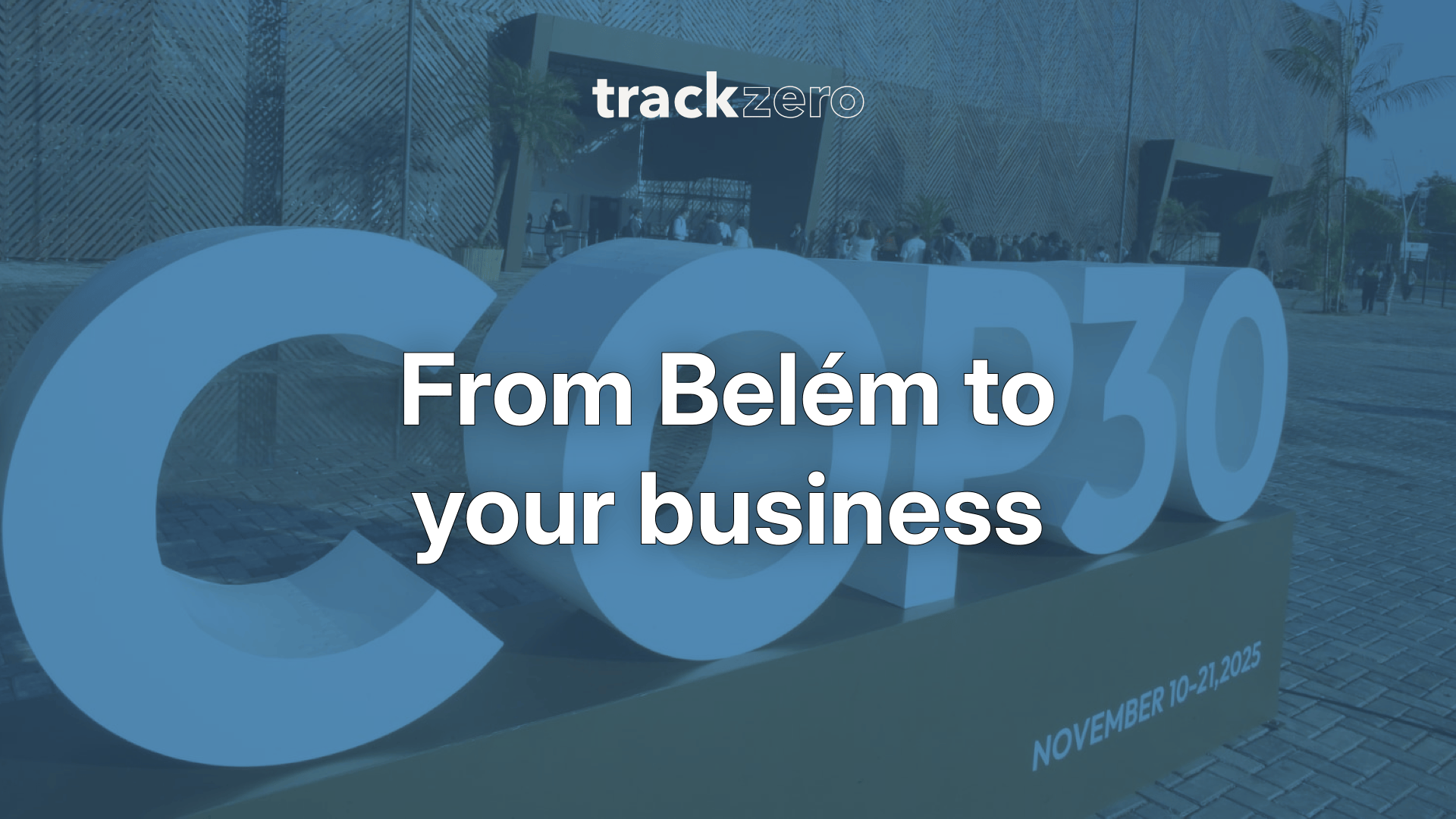
COP30 in Belém didn't end the way many climate advocates hoped. A group of countries pushed hard for a clear roadmap to move away from fossil fuels; others pushed back just as hard. The final agreement stopped short of the strong anti-fossil fuel language many businesses and NGOs were calling for.
If you only skimmed the headlines, you might conclude that climate diplomacy is stuck.
But that's not the full story and it's not the story that matters most if you're running or working in a business.
Under the surface, COP30 sent some very practical signals about where regulation, investor expectations and markets are heading next. Those signals point to three big themes:
- the transition is still moving forward,
- adaptation and resilience are moving centre‑stage, and
- clean electrification will shape a lot of business decisions over the next decade.
At TrackZero we watch these shifts closely. Here's what we think is worth your attention and what it means for how you manage data, risk and opportunity in your organisation.
1. The transition is "irreversible" – even if diplomacy is messy
Despite the drama in the negotiating room, 194 countries signed up to language that matters:
- The global transition to low greenhouse gas emissions and climate resilience is irreversible and the trend of the future.
- That doesn't magically solve politics or guarantee strong policies everywhere. But it does confirm a direction of travel that's very unlikely to reverse.
A few points that got less attention than they deserved:
- Emerging economies are in the driving seat. China is now the world's largest clean‑tech manufacturer. India is rapidly expanding clean power. Saudi Arabia is importing huge amounts of solar to replace oil‑fired power. These markets are helping push costs down and scale up new technologies.
- Business engagement was strong. Despite talk of "climate fatigue", companies turned up in numbers. Within 48 hours, 150 business coalitions representing more than 140,000 companies backed a call for a fossil‑fuel transition roadmap. Many of them were asking not for looser rules – but for clearer ones.
For businesses, the takeaway is simple: climate policy will move in fits and starts, but the underlying transition is not going away. Planning for a high‑carbon status quo is increasingly a risk, not a safe default.
2. Adaptation and resilience: from words to budgets
For years, climate conversations in business have focused on mitigation – cutting emissions. COP30 didn't change that, but it did accelerate a quieter shift: adaptation and resilience are moving from narrative to numbers.
What does that mean in practice?
- More focus on physical climate risk. Heatwaves, floods, storms and water stress aren't abstract future risks anymore. Regulators and investors are asking: where are your assets, people and key suppliers exposed? How will that affect your operations, costs and revenues?
- New adaptation metrics. Governments agreed new global targets for adaptation and resilience. Over time, these will filter into national regulations and voluntary standards.
- From disclosure to implementation. Many larger companies already report on climate risk. The next step is harder: turning those risk assessments into concrete investments in cooling, flood protection, diversified suppliers, employee safety and more.
This is particularly challenging for small and mid‑sized businesses. They're often being asked for more climate and risk data by larger customers, but don't always have the tools, time or budget to respond.
This is exactly the gap TrackZero is designed to close. We give SMEs simple, guided tools to collect the right data without needing specialist knowledge, and we give enterprises a scalable way to gather accurate, audit-ready information across their supply chain.
3. Clean electrification is the next big wave
One clear thread through the COP30 discussions was the growing focus on clean electrification – using low‑carbon electricity to power more of the economy.
Think:
- Electrifying vehicle fleets
- Replacing gas boilers with electric heat pumps
- Shifting industrial processes to electric where possible
- Powering all of this with renewable electricity, ideally as local as you can get it
Why does this matter so much?
- Cost and volatility. Once installed, renewables like solar and wind have very low running costs. They can help reduce exposure to fuel price spikes.
- Energy security. Countries, and companies, are keen to rely less on imported fossil fuels. Rooftop solar or local renewables give more control.
- Policy alignment. Whether or not there's a global fossil fuel roadmap, many governments are already tilting their incentives towards electrification.
COP31 (hosted in Turkey, chaired by Australia) in 2026 is widely expected to focus more explicitly on global goals for electrification. For businesses, that means boards and leadership teams will increasingly ask:
- How much of our energy use can we realistically electrify, and when?
- What would that do to our emissions – and our operating costs?
- What investments do we need to plan for over the next 5–10 years?
Having robust, up‑to‑date emissions and energy data will be key to answering those questions.
4. What this means for carbon accounting
All of this – an "irreversible" transition, more attention on physical risk, and a push towards electrification – lands squarely on the systems you use to track and manage climate data.
We see three big implications:
- Carbon accounting is no longer just a reporting exercise.
Emissions numbers are becoming inputs into real business decisions: where to invest, how to design products, which suppliers to work with, how to talk to lenders and insurers. - You'll need to connect emissions to risk and resilience.
Knowing your Scope 1–3 footprint is step one. Step two is overlaying that with questions like: Where are these emissions happening? Which sites are climate‑exposed? Which suppliers are critical, and how vulnerable are they? - Standards are converging – and expectations are rising.
Frameworks like IFRS S2, UK sustainability standards and the EU's CSRD are nudging companies towards more consistent, comparable climate disclosures. That means higher expectations around data quality, auditability and the link between your targets and your actual transition plan.
How TrackZero can help
TrackZero is built for exactly this stage of the transition: simple tools for SMEs, scalable data collection for enterprises and audit-ready information that stands up to growing scrutiny.
Our software helps organisations:
- Collect accurate, primary emissions data from suppliers using simple, guided assessments
- Drive high supplier engagement across Scope 3 with automated onboarding, reminders and support
- Measure emissions across Scopes 1, 2 and 3 with clear, transparent and fully auditable methodologies
- Turn raw data into decision-ready insights for finance, procurement and sustainability teams
- Stay aligned with evolving reporting and assurance requirements without relying on fragile spreadsheets or manual processes
COP30 reminded us that global summits often generate more noise than results. But while diplomacy stalls, the transition itself is moving. Companies that treat climate data as essential business information will be the ones that stay ahead.
If you'd like to talk about how to make your carbon and climate data more useful for real‑world decisions, we'd love to chat.